Hidden event costs: the categories every template leaves out

Table of Contents
An event budget can look finished and still be thousands of dollars short.
The venue rental is in there. So is the catering quote, the audio-visual proposal, the speaker fees, and the marketing costs. Those numbers arrive early, come from vendors, and are straightforward to put on a page. The hidden event costs live somewhere else: around people, freight, percentages, attendee requests, and the work that continues after the room is empty.
Six categories cover most of what an event budget template leaves out. Whether you're planning a retreat, a conference, or a corporate event, add all six as named rows now, then fill in the numbers as quotes and answers come back. That's what gives you the full picture before you approve anything.
Key takeaways
Your own team is a hidden event cost. Travel, hotel nights, meals, transportation, setup hours, minimum labor calls, and overtime fees all count, even when payroll sits somewhere else.
Freight is a cycle rather than a single charge. Shipping, receiving, storage, handling, delivery, return labels, and missed pickups each carry their own cost.
Service charges, taxes, payment processing, and registration fees are calculated from different bases, and the base matters more than the rate.
Headcount guarantees make no-shows billable. Review guaranteed numbers before confirming catering, rooms, or any per-person commitment.
Post-event charges need their own rows. Cleaning, damage, overtime, final labor reconciliations, media deliverables, gifts, and late pickups all arrive after the room clears.
Keep a named contingency line at 10 to 15 percent and review it before every major commitment.
Hidden event costs start with your own team
The people producing your event belong in the event budget, even when they're employees, regular collaborators, or contractors paid elsewhere. Payroll treatment doesn't remove those costs. It only changes where they appear.
List each person's home city, arrival and departure dates, hotel nights, meals, transportation, and expected work hours. That single list turns a category most budgets skip into five or six rows you can price.
Early access can add a full night of team expenses
A nine in the morning opening session usually means your team arrives the afternoon before. If the venue only grants load-in access at four, setup runs through dinner and into the evening.
That access window adds a hotel night, airport transfers, dinner, and paid setup hours for every person on site. Put the early arrival in the budget before you book the room block, because by then the decision is already made.
Minimum labor hours apply before your guests arrive
A two-hour setup can still be billed as a four-hour call. Venues, production crews, transportation providers, and contract staff usually work from minimum shifts.
Record the minimum hours, the overtime fees, the holiday rate, and setup and strike time separately. Then keep real-time tracking of hours on site during build and strike, because the final invoice will be built from actual hours and you want your own record to compare against. Budgeting only for guest-facing hours leaves out the work that makes them possible.
Everything you ship arrives twice in the event budget
Freight starts with the outbound shipment and then keeps going. Branded materials, gifts, signage, AV equipment, and supplies each need a plan for delivery, receiving, storage, movement into the room, and return, and event vendors frequently charge for each stage separately.
Track box count, estimated weight, ship date, delivery window, return address, and who pays at each point. A shipment sent early sits in paid storage until your contracted access date. A return shipment needs its labels and carrier pickup arranged before doors even open.
Venue handling and storage fees appear before your event starts
A venue may charge to receive, log, store, and deliver every package. When those charges don't appear in the initial freight quote, they become hidden fees, billed per box, per pallet, or by weight, with separate rates for anything oversized.
Room drops are their own line. If gifts or welcome materials go to guest rooms, the hotel charges per room to deliver them, and that charge has nothing to do with what the gift cost.
Create separate budget rows for shipping, receiving, storage, special handling, room drops, and delivery to the event space, and note who pays each one. Small per-box charges and missed-pickup fees add up to real margin leakage. The same principle applies to everything else in that contract, which is why [LINK: the vendor questions no one preps you for] are worth asking before you sign.
Return freight needs its own estimate and its own deadline
The return trip often costs more than the outbound one, once boxes are repacked, relabeled, weighed, and held overnight. A missed pickup means rush shipping, another storage charge, or materials left behind entirely.
Assign one person to confirm what ships back, where it goes, and when the carrier arrives. That job needs an owner before the closing session begins, because nobody volunteers for it afterward.
The percentages on top of every other number change your total
A percentage looks small until it lands on several parts of the same invoice. Service charges, taxes, payment processing, and ticketing fees each need their own budget line, because each one is calculated from a different base.
Catering quotes often carry service charges that don't appear in the food and beverage number you compared against another venue. An open bar may carry different charges from the rest of the menu. This breakdown of catering budget charges is a useful reminder to read past the menu total.
Here's a simple illustration for a corporate event, using round numbers rather than quoted rates:
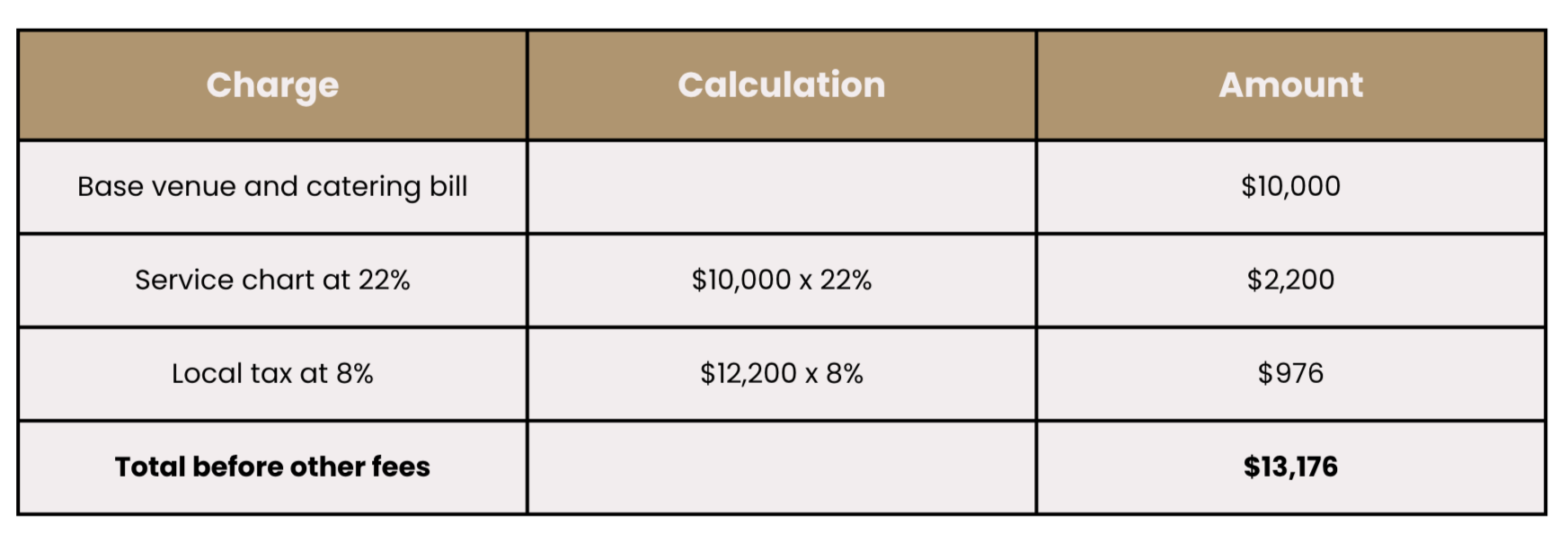
That's $3,176 on top of the number you built the budget around, and it came from layered charges rather than one surprise. Layers like these are how budget overruns start. Ask whether each percentage applies to rental, food, labor, equipment, freight, or the full subtotal.
What does a venue service charge apply to?
A venue service charge can apply to room rental, catering, audio-visual equipment, and labor, depending on which services your contract names. It rarely stops at food and beverage.
The rate matters, and the base matters more. Record both the percentage and the exact charges it covers, then calculate the service charge before you add tax. Watch for the smaller fixed fees in the same section of the contract: a corkage fee if you supply your own alcohol, a cake cutting fee if dessert comes from outside, and separate charges for power and internet, since wifi access in a meeting room is almost never included at the bandwidth a live event needs. Examples of fee layers on event invoices show why an original quote rarely tells the whole financial story.
Registration fees grow with every paid transaction
Registration costs are driven by transactions rather than by revenue. One guest paying in installments creates several processing charges. Refunds, discounts, transfers, and complimentary registrations can each carry a platform fee of their own.
Estimate from the expected number of card charges and ticket actions instead of from the revenue total. A $20,000 target produces very different fees depending on whether twenty people pay once or a hundred people use payment plans.
Get an honest read with the free Event Pulse Check
Your budget connects to the venue, your communications, your team roles, and your day-of plan. A number in a spreadsheet can't tell you whether all of that is ready to work together.
The free Event Pulse Check gives you an honest read on where your event stands across the pieces that have to support each other before event day.
The people in the room create costs your template cannot predict
Attendee needs reshape a budget after registration opens, which is the one thing a template built in advance can never account for. Dietary requests, accessible transportation, live captioning, ASL interpreters, mobility support, reserved seating, and late meal changes all arrive after your first numbers are written down.
Keep two lines here rather than one: a known allowance and a variable amount. Set a review date for updated counts, then bring new requests into vendor conversations while there's still time to price them properly.
Dietary and accessibility requests need money and lead time
A dietary request can mean separate preparation, a higher per-person price, special equipment, a second vendor, or additional staff hours. Accessibility requests deserve exactly the same advance planning.
Price captioning, interpreters, quiet spaces, accessible seating, and transportation as real budget lines rather than as favors arranged in the final week. Catering expenses beyond the menu price include special meals and the added service details that come with them.
Meal and room guarantees charge you for people who don't arrive
Headcount guarantees define the number of guests you've agreed to pay for, whether or not they show up. Per-person packages and an open bar stay billable when registered guests don't arrive.
If your final catering guarantee is 80 people at $95 each and six guests don't come, the bill is still $7,600. Record the guarantee deadline, the billed minimum, the per-person rate, and the fee for changes after that deadline. Your actual attendance and your billed attendance are two different numbers, and only one of them appears on the invoice.
Some event costs arrive after everyone goes home
The last attendee leaving doesn't close the budget. Cleaning charges, damage assessments, labor reconciliations, overtime fees, equipment returns, and late pickup charges arrive once event vendors compare the actual work against the estimate, which can take a week or two.
Keep a post-event closeout list carrying open invoices, deposits to recover, damage notes, final attendance, and anything you promised someone. Most of what you need for those last vendor conversations was decided during [LINK: the stretch between the venue being booked and event day], which is where the contacts and timing live.
The final invoice reflects actual labor, not the estimate
Room flips, delayed sessions, late strikes, added setup, and a longer load-out all move the labor total and can trigger overtime fees. Compare the final invoice against the approved scope, the recorded hours, and any signed change orders before you mark a line complete.
Gifts and media deliverables usually have a second bill
A video shoot quote often excludes editing, captions, revisions, storage, extra footage, and final delivery. Speaker and team gifts need their own lines for packaging, personalization, shipping, and replacements.
Budget the full delivery rather than the first service. A quote that looks tidy at the start frequently covers only the first half of the work.
A 10 to 15 percent contingency gives hidden event costs somewhere to go
A contingency line needs to be its own named row. Padding folded into other categories gets spent invisibly, and at the end of the event you can't see what pulled from it.
Set aside 10 to 15 percent of your working budget, using the higher end for a new venue, unfamiliar vendors, travel, a short timeline, or complex production. It doesn't replace detailed estimates. It absorbs the distance between an estimate and a final invoice, which is a distance that exists no matter how carefully you plan.
Your contingency percentage should match the event's uncertainty
A smaller event can still need a larger reserve when it has a lot of moving parts. Look at location, lead time, vendor count, travel, production needs, and how many decisions are still open.
Log every contingency draw with the reason, the amount, and the remaining balance. That record is the single most useful thing you'll have when you price the next event, and it's how you keep budget overruns from repeating.
Run a budget review before each major commitment
Before approving a major contract, update your known quotes and your percentage-based fees. Check headcount guarantees, bar packages, freight plans, overtime fees, team travel, and any permits and licenses your venue doesn't already carry.
For a new venue or a high-value corporate event, get quotes for event cancellation insurance and event liability insurance and put both on the budget as their own lines. Then compare what's left in contingency against everything you still need to book.
That review takes far less time than untangling a final invoice for something you already signed. Most of these numbers get set early, which is why [LINK: the five decisions to make when planning an event from scratch] have such a long tail.
Frequently asked questions
What are hidden event costs?
Hidden event costs are expenses that don't appear in the first venue, catering, or AV quotes. They include team travel, freight handling, service charges, attendee requests, post-event labor, and charges that arrive after the main budget is built.
How much contingency should an event budget include?
Set aside 10 to 15 percent of the working budget. Use the higher end for unfamiliar vendors, travel, complex production, short timelines, or decisions that are still open.
Can I be charged for guests who do not attend?
Yes. Catering, rooms, bar packages, and other per-person commitments are usually billed against a guaranteed headcount rather than actual attendance. Record the guarantee deadline, the billed minimum, the per-person rate, and the cost of changes after the deadline.
Which fees should I ask a venue to explain?
Ask what the service charge, taxes, labor fees, freight handling, storage, delivery, corkage, power and internet, and overtime charges each apply to. Record both the rate and its calculation base, because a small percentage creates a large total when it lands on several parts of the invoice.
What should I include in a post-event budget review?
Check cleaning, damage, overtime, final labor, equipment returns, late pickups, gifts, media deliverables, and open vendor invoices. Compare each final charge against the approved scope, the recorded hours, signed change orders, and any deposits still owed back to you.
Put the missing rows in your budget this week
Open your current event budget and add six named rows before you enter another number: team, freight, added percentages, attendee needs, post-event charges, and contingency.
Give each row an owner, then write either an estimate or the question that still needs answering. The service charge base. The storage rate. The labor minimum. The accessibility quote. The date the final invoice arrives.
A hidden event costs row sitting at zero is a question you'll answer. A row that doesn't exist becomes an invoice four months later.