How to compare event venue proposals before you sign
Table of Contents
I should say up front that my manager usually handled the proposals themselves. We also worked with a third party who sourced places for us, and what they'd send back was a single sheet showing where each venue was, what concessions were on the table, the room rates for both sleeping rooms and meeting rooms, and the food and beverage minimums, all lined up in the same columns. That sheet is the thing worth copying, and you can build it yourself.
Two or three proposals arrive, each formatted differently, each leading with a number that isn't the number you'll pay. One quotes a rental fee with catering separate. One quotes a per-person package that excludes the meeting space. One is a beautiful PDF with a photograph of a terrace and almost no figures at all. Comparing them as they arrive is close to impossible, which is rather the point of how they're written.
This is operational and financial guidance rather than legal advice. A venue contract is enforceable and clauses vary by jurisdiction. For a high-value booking, anything international, or a contract with broad liability language, get qualified local legal advice.
What a contract for renting a venue actually commits you to
A venue rental agreement sets out what event space you get, for what rental period, what you pay, and what happens when something changes. Most of them cover the same ground: a venue description naming the actual rooms, the event details and dates, guest capacity, the rental fee and payment terms, a reservation deposit and a security deposit, setup and cleaning responsibilities, insurance requirements, a cancellation policy, termination conditions, an indemnification clause, and a governing law clause.
The rental fee is the part everyone reads. The parts that decide what you actually spend are the minimum commitments, the cancellation exposure, the mandatory suppliers, and the long list of things the headline number doesn't include.
Build one comparison sheet and convert every proposal into it
Ask each venue to state the same things in the same units, so you can read across rather than down.
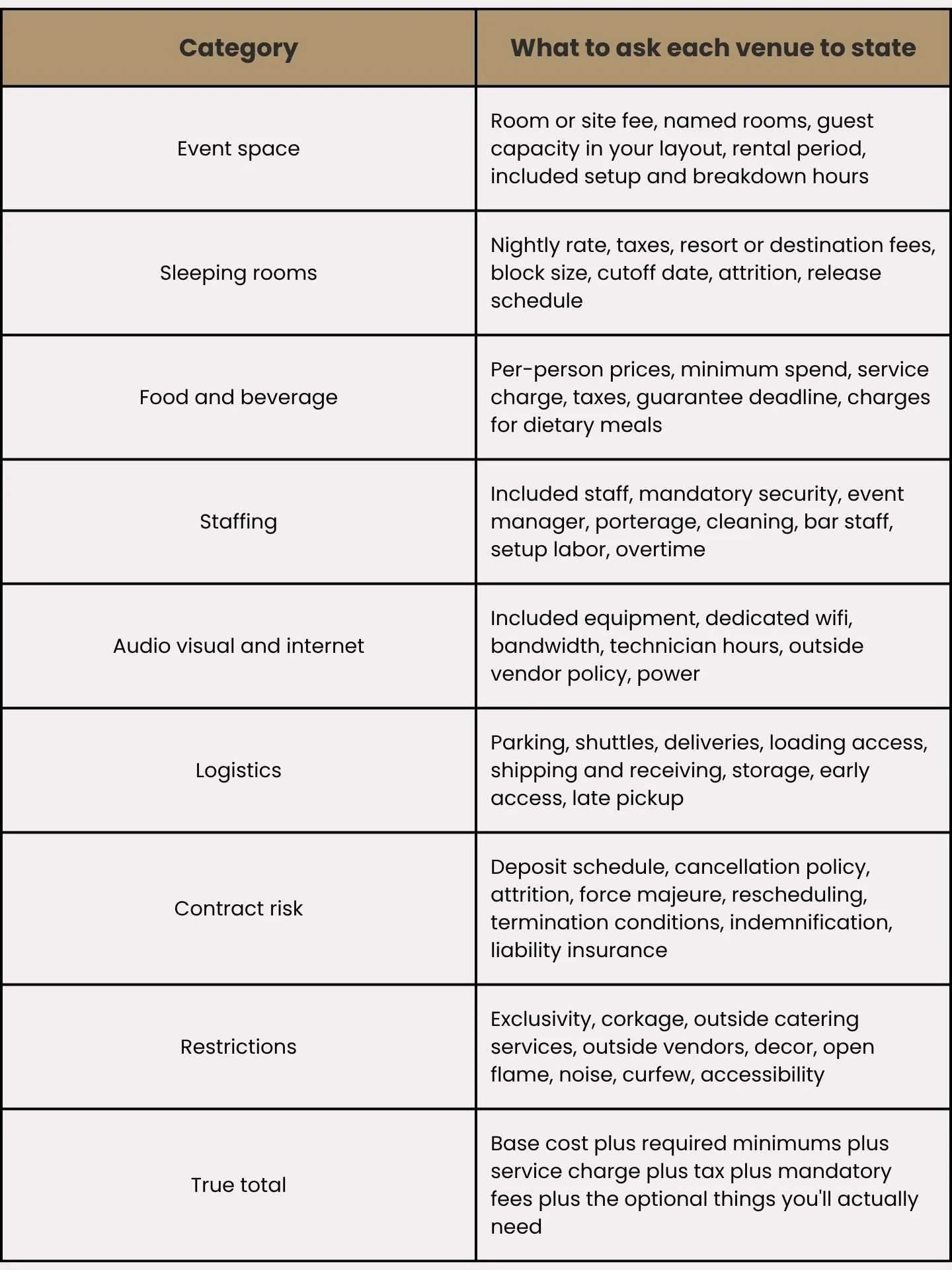
The comparison that matters is the all-in total at your realistic attendance, rather than the room rate, the day delegate rate, or the package price. Meeting Professionals International recommends a request for proposal ask for an itemized estimate covering menus, minimums, service charges, staffing assumptions, exclusivity restrictions, cancellation, attrition, force majeure, payment terms, taxes, price-change language, and damage clauses. MPI sells membership and certification to event professionals and writes for corporate procurement, so the itemized approach transfers to a forty-person retreat while the exhibitor and sponsor sections don't.
The clauses that cost money later
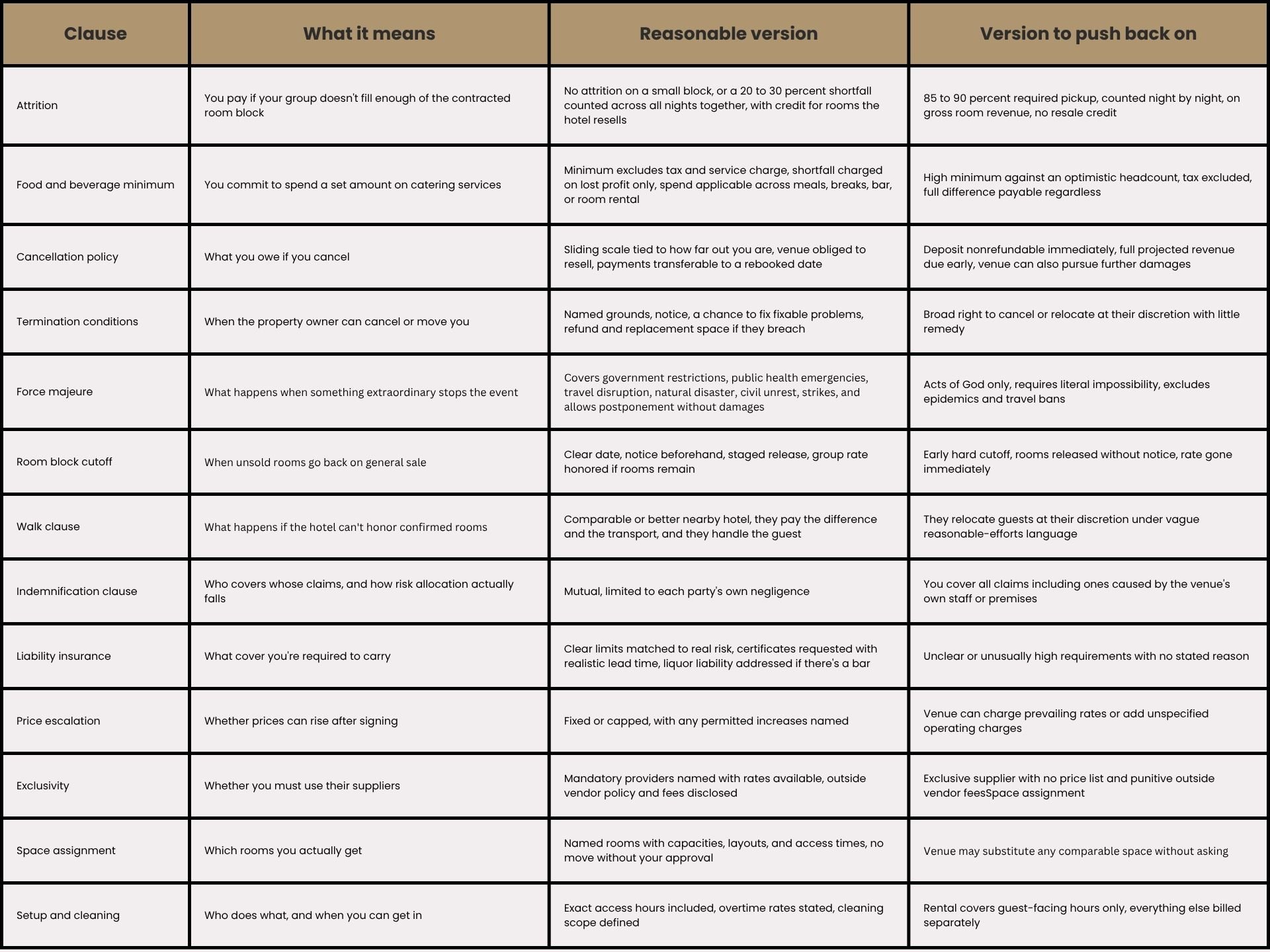
A professional society's venue guide advises groups booking forty rooms a night or fewer to push for no attrition at all, and to ask whether pickup is counted cumulatively or per night. Law firm guidance on hotel contracts adds that attrition damages should be calculated on lost profit rather than lost gross room revenue. Both are association-focused sources, and both transfer well to a small booking.
Force majeure, and reading it the way everyone reads it now
Post-COVID, this is the clause I'd look at every single time, because what it really tells you is how you get out of the contract if you need to.
The version you want covers more than acts of God: government restrictions, public health emergencies, epidemics and pandemics named explicitly, travel disruption, natural disaster, civil unrest, strikes, utility failure, and the venue or its transport access being closed. Two details decide whether it's usable.
The trigger. A clause requiring performance to be literally impossible is close to useless. What you want is language covering an event made illegal, commercially impracticable, unsafe, or materially affected. ASAE, the association executives' body, recommends exactly that materially-affected standard, and suggests language covering the case where a meaningful share of guests can't or won't travel.
What happens to your money. The clause should say whether deposits are refunded or transferred to a mutually agreed date. A force majeure clause that releases both parties from performing but keeps your deposit isn't protecting you. PCMA recommends the clause expressly name disease, epidemic, and pandemic. Both PCMA and ASAE sell membership and education to event professionals, so neither is neutral, though on this point they're recommending something that costs venues rather than organizers.
Jurisdiction changes what these clauses mean
The governing law clause usually sits near the end and gets skipped, and it decides which state's or country's law applies and where a dispute would be heard.
It matters most for the two clauses with the widest variation. Indemnification is limited by statute in some US states, particularly one-sided provisions asking you to cover a venue's own negligence, and enforced far more freely in others. Force majeure is interpreted differently too, since some jurisdictions read these clauses narrowly against whoever drafted them and others give more weight to commercial impracticability.
The practical version for a small organizer: check that the governing law is somewhere you could realistically pursue or defend a claim, and be more careful about broad indemnification and liability insurance language when you're booking abroad. That's the point at which the advice stops being operational and starts being a reason to have a local lawyer read it.
The line items that surprise people on the final bill
Service charge and administrative fee. A percentage added to food and beverage, and not automatically a gratuity going to service staff. Ask the exact percentage, what it applies to, and whether tax is charged on top. Trade reporting has put these as high as 28 percent at some properties, which is meetings-industry commentary rather than a survey, so treat it as a reason to calculate all-in cost rather than a standard rate.
Room rental that reappears. Often waived on the assumption you'll hit the food and beverage minimum, so ask what happens if you don't.
Setup, breakdown, and overtime. Rehearsals, early access, room resets, late collection, and the hourly rate outside your contracted hours.
Audio-visual and labor. Equipment, a technician, a minimum call time, and overtime rules. Ask whether the in-house provider is mandatory.
Internet. Guest wifi and production wifi are different products at different prices. If you're streaming, ask about a dedicated line and concurrent-user capacity.
Power, corkage, and outside vendor fees. Dedicated circuits and electrical drops aren't included in the room, and corkage is charged per bottle while vendor fees are charged per supplier.
Delivery, receiving, storage, cleaning, waste, security, parking, credit card surcharges, and staff meals for your vendors and crew. There's more on the categories that go missing from a budget entirely in hidden event costs.
The risk is different depending on the venue
Hotels and conference centers. Standardized, commercially sophisticated contracts, so the risk is financial complexity and clauses favoring the venue: attrition, walk clauses, room rental tied to minimums, resort fees, detailed cancellation schedules. The upside is real, since a commercial venue of that kind already has systems for catering, guest rooms, audio-visual, accessibility, parking, security, and check-in.
Retreat centers. Often a bundled per-person package, and frequently no attrition or walk clauses because you're booking exclusive use. Ask whether you're paying for every bed, a minimum occupancy, or a full buyout, and which bedrooms, bathrooms, meeting spaces, and outdoor areas are included. Then ask about overnight staffing, curfew and noise limits, weather backup for anything outdoors, heating and cooling, internet capacity for your real group size, and whether linens, towels, activities, and cleaning are extra.
Villas, private estates, and private homes. The least standardized agreements, and closer to a lease agreement than an event contract in places. Check event permission and occupancy caps, local permits, whether tables and chairs and glassware and amenity items and waste bins are included, kitchen access and catering rules, alcohol licensing and liquor liability, power capacity, rain backup, neighbor restrictions, insurance requirements, and who's responsible if a vendor damages the property.
Independent event spaces. Usually include basic furniture and an event manager, and usually exclude catering, bar, audio-visual, security, cleaning, internet, power, staffing outside regular hours, and setup time.
The useful distinction: with hotels, the danger is financial complexity in a document covering everything. With villas and independent spaces, the danger is a simple document covering almost nothing, and a lower rental fee is not a better proposal if you then have to hire ten functions somebody else would have included.
What to ask before you sign
Every one of these should be answered in writing.
Price and inclusions. What's the all-in estimate including service charge, gratuity, tax, required staff, cleaning, security, furniture, audio visual, wifi, power, setup, and mandatory supplier fees? Which charges are fixed and which can change? Is tax charged on the service charge? What's the deposit and payment schedule, and are there card fees? What happens if our numbers come in below estimate?
Access and operations. What exact hours can we access the property for delivery, setup, rehearsal, the event, breakdown, and collection, and what does anything outside those hours cost? What's the guest capacity for the layout we want rather than the marketing capacity? What's the wet weather plan, and is the backup space included and big enough? What are the noise limits, curfew, and open flame rules? Who moves furniture, resets rooms, and clears waste?
Food, drink, and suppliers. Is there a food and beverage minimum, and is it calculated before or after tax and service charge? Can unused minimum spend move to other items? What's the final guarantee deadline, and how are last-minute reductions handled? Are outside caterers, bar suppliers, and audio-visual teams allowed, and what are the fees? What's the dietary and allergen process, and who owns the handoff to the kitchen?
Rooms. Which room types and dates are held, and what's the cutoff? Is there attrition, and is pickup counted cumulatively or nightly? Are resort fees, parking, breakfast, and taxes included in the quoted rate? What happens if the property can't provide confirmed rooms?
Protection. What's the cancellation schedule, and can deposits move to a rebooked date? Is the cancellation fee the venue's only remedy? Does the venue have to try to resell? Can they move our event or our guests, and what are our approval rights? Is indemnification mutual and limited to each party's own negligence? What insurance is required, and what must the certificate say?
There's a wider set of questions worth asking every supplier in the vendor questions no one preps you for.
What's genuinely negotiable
We did a lot of negotiating, and the concessions column on that sourcing sheet existed because there was always something to move.
Usually movable, even on a small booking: line-item disclosure of the all-in price, a smaller room block or staged release, no attrition or more allowable attrition, cumulative rather than nightly pickup, resale credit, a block reduction date, a lower food and beverage minimum or more flexibility in how you spend it, waived or reduced room rental, setup and breakdown access, wifi included, basic audio visual included, parking, a workable guarantee deadline, a cancellation policy tied to timing, deposit transfer to a new date, clearer force majeure language, named rooms with no move without approval, and a price lock when you book well ahead.
Rarely movable: statutory taxes, large fixed service charge percentages, the venue's own insurance requirements, fire code occupancy limits, local licensing, union labor rules, mandatory security at certain venue types, core catering and alcohol exclusivity at full-service hotels, peak-date pricing, noise curfews, and resort fees at large properties. When a fee won't move, ask for a trade instead: waived room rental, wifi included, a smaller minimum, extra setup time, a parking discount, credit toward audiovisual, or staff meals thrown in.
What doesn't apply to a forty-person event
Most published contract guidance is written for corporate events at scale and for association conferences, so some of it sends you chasing things you don't need. Large room-block concessions depend on room-night volume you won't have. Complex attrition formulas are irrelevant if a retreat center is selling you exclusive use. Convention center issues around exhibit halls and union rigging don't touch you. Multi-year volume isn't available to somebody running one event a year. A twenty-page procurement document is also unnecessary when a clear one-page requirements sheet gets you comparable proposals.
The advice that everything is negotiable is an aspiration rather than a promise. A small independent property in peak season may genuinely have a take-it-or-leave-it calendar.
Where to start
Build the comparison sheet before you request anything, so you're asking every venue for the same fields rather than reverse-engineering three different PDFs afterward.
Then work out your realistic attendance number, the one you could serve well rather than the one you're hoping for, and price every proposal at that number. Most of the expensive mistakes in a contract for renting a venue come from committing to a headcount before that number was settled, and there's more on settling it in how to plan an event from scratch.
Anything you can't explain back to somebody in plain language is a clause to ask about before signing, rather than after.