Run of show meaning: the production document for your day
Table of Contents
We opened one conference with "Good Morning Baltimore" playing, and it started exactly one minute before the welcome remarks, timed so the last of the room found their seats while it was still going and the host walked on as it faded.
Nobody in that audience thought about the music, and nobody was supposed to. The song was on a document that guests never saw, sitting alongside which microphone the host was holding, the name of the person handling time cards, and the exact wording of how she'd pass to the speaker after her.
That document is the run of show, and the thing worth knowing early is who it's written for. It doesn't go to your guests, and it isn't the sheet you and your team run your logistics from either. It goes to the people producing the day.
What a run of show actually is
A run of show is the production document for your event day. It sets out each block of the day in order, what happens inside it, who from your team is working it, and what has to be cued alongside it: the music, the microphones, the timing signals, and the wording of each transition from one person to the next. Your production team runs the day from it.
Everything on it is written so somebody who has never met you could execute it. If a line only makes sense to the person who wrote it, it isn't finished.
Three documents, and each one goes to different people
Most of the confusion around this term comes from treating one document as three, so here's how they actually split.
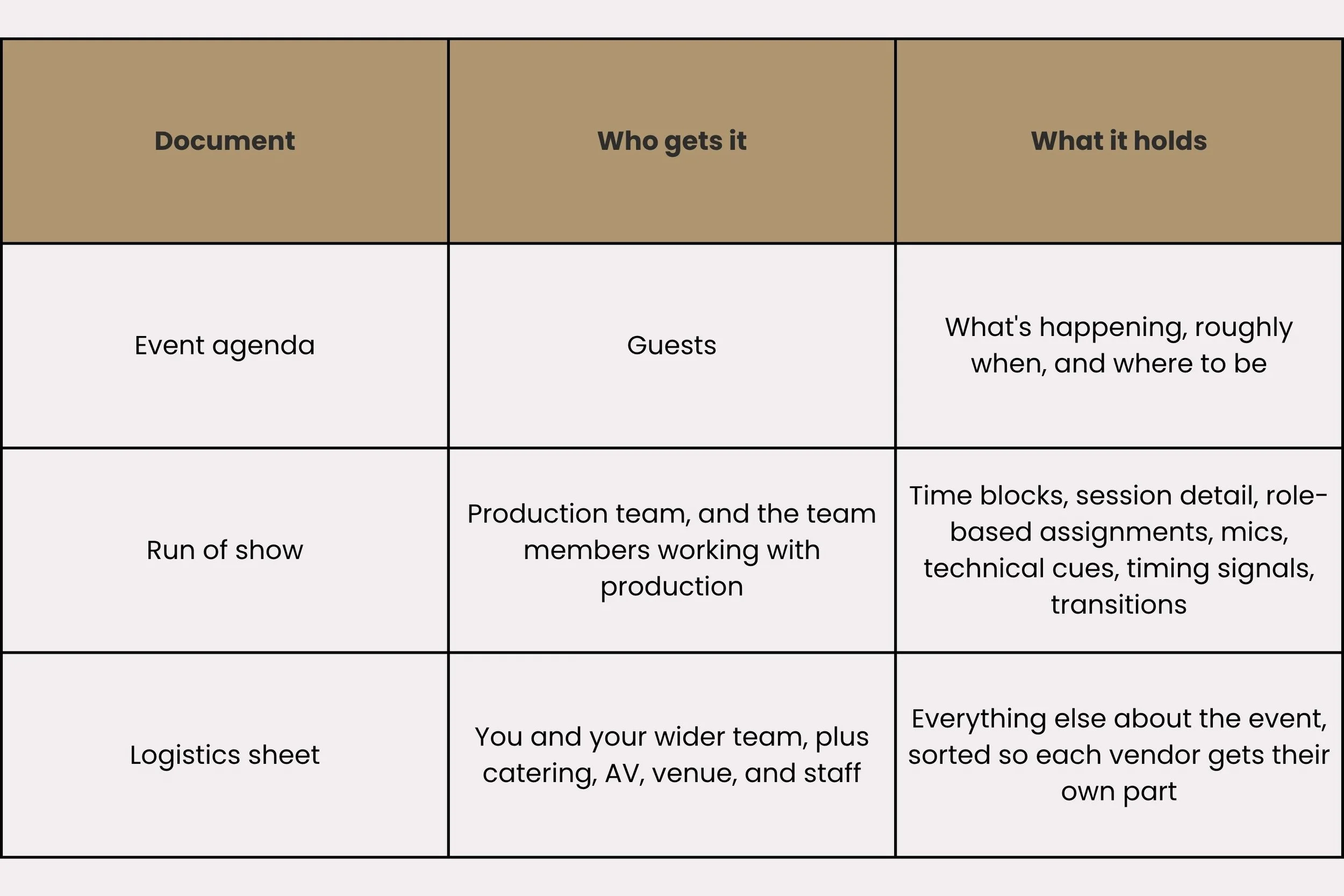
Your guests get a version of the day that reads well. Nobody wants a schedule telling them a brand video plays for two to three minutes before the next session. They want to know the panel starts at eleven and lunch is at one.
Your production team gets the version with the two to three minutes in it, because that number is the reason the next speaker is standing in the right place when the room settles. Event managers running corporate events at any scale work from this document rather than the event schedule, since the schedule tells you what's happening and this tells you how it happens
Two other names float around, and it's worth knowing where they land. A production schedule usually means the build and strike on either side of your event, so the load-in, the rehearsal, and the breakdown. A cue sheet is narrower still, and it's the audio-visual team's own document covering sound, lighting, and video triggers, often pulled straight out of the run of show. Your run of show is the master document those two hang off.
Your vendors and your wider team get their own thing again. Catering doesn't need mic assignments and the stage manager doesn't need the delivery window for the linens. A well-built run of show will actually point at that other document by name when somebody needs detail it doesn't carry, which is a good habit worth copying. There's more on that side of it in what belongs in your event planning spreadsheet.
What goes on a run of show
The layout that works is a two-column table. Time block on the left, everything about that block in one cell on the right. Sessions get a full cell. Breaks, meals, and open time get a single line and nothing else, because there's nothing to run.
Inside a session cell, the same things appear in the same order every time.
Who's working it, in a fixed pattern
This block sits at the top of every session cell, and it never changes shape, so anyone can scan for it. Leads, then microphone one, then microphone two, then time cards. Names, not roles, because on the day somebody has to actually be the one. These role-based assignments are the part your event team will scan for first, which is exactly why they sit in the same place in every cell.
Time cards deserve their own mention, since it's the role people leave off. Somebody stands where the speaker can see them and holds up the card telling her she has ten minutes left, then five, then wrap. Without a named person doing that, sessions run long and every session after it pays for it.
Breakouts run a smaller version of the same pattern. One lead, one person on notes and the microphone, one timekeeper. Same shape, fewer people.
The room, on every single line
Every session names its room. Your team knows where the main room is. A day with a breakout track has four rooms running at once, though, and the document has to be readable by somebody standing in any of them.
The technical cues
Music, with the actual song title on the page. Which slide or video is up. Lighting cues, meaning when house lights drop and when they come back. Which microphone each speaker is holding and when it gets handed over. Speaker cues belong here too, meaning the words or the moment that tells somebody they're on.
If your audio visual team is building its own cue sheet, this is the section they'll build it from, so write it as though somebody who wasn't in the planning conversations has to execute it cold.
Running the sessions as hybrid events or virtual events adds a second set of cues on the same lines. When the live streaming starts and stops, who's watching the chat, who reads a question from a remote guest into the room, and what happens if the feed drops mid-session. Put those in the same cell as the in-room cues rather than a separate document, because the person calling one is usually calling both.
The transitions, written as sentences
Label these, and write out what actually happens. Write the full line rather than the word handover: she closes the session and welcomes the moderator and panelists to the stage for the next one, then explains what that panel covers.
Written down, that's twenty seconds. Left off, it's a pause where four people look at each other.
The transition is also where movement gets instructed. One group returns to the main room at noon, the other moves to the second room after the break. If your day splits into tracks, that sentence is the only thing preventing half the room from going the wrong way.
What the session actually is
Full session description on the document, the same paragraph your speakers wrote. It looks like overkill and it isn't, because the person on the microphone needs to introduce the session, and the person on time cards needs to know whether it's a panel or a workshop before deciding how hard to signal.
Setup instructions, with their own times
These live in the same cell as the session they serve, and they carry a time of their own. Staff set the materials on the tables at two o'clock for the session that starts at two thirty. The brand video runs two to three minutes leading into the session. The banner goes up before the reception and comes down after, with names on both.
Buffer time, and what happens when the day slips
Sessions run long. A panel gets good, and nobody wants to stop it; a speaker arrives late from the airport; the coffee takes twenty minutes to come out. Live event execution is mostly the management of small overruns, and the document either helps with that or it doesn't.
Two things to build in.
Buffer time between blocks. Ten minutes at the end of a session that doesn't need ten minutes. A break scheduled at thirty that can genuinely run at twenty. If your day is packed end to end with no give in it, the first overrun eats the last session of the afternoon, and the last session is usually the one people remember.
Contingency plans, written down and short. Two or three lines is enough. What gets cut first if you're twenty minutes behind by lunch, and who decides. Where the session moves if the outdoor plan gets rained off. Who covers the microphone if the person assigned to it is dealing with something else.
That last one sounds excessive until the day somebody has to leave the room mid-session, and every event organizer I know has a version of that story.
Two things that belong at the end
Most run-of-show templates stop at the last session. The ones that work in practice carry two more pieces.
A materials list. Every physical item the day needs, in one place. Notepads and pens for the workshop. Table numbers and stands for the roundtables. Time cards. Speaker gifts. Anything a staff member has to carry into a room and set down.
A staff roster. Everyone working the event, with their home location and which days they're actually on site, because half the team arriving Friday and leaving Saturday changes who can be assigned to what. Note the late arrivals and the early departures. That single list is what stops you from assigning Sunday morning breakfast to somebody who flew out the night before.
A morning of one, written out
Definitions only take you so far, so here are the first few hours of a one-day retreat for twenty-four people, at the level of detail this document actually needs.
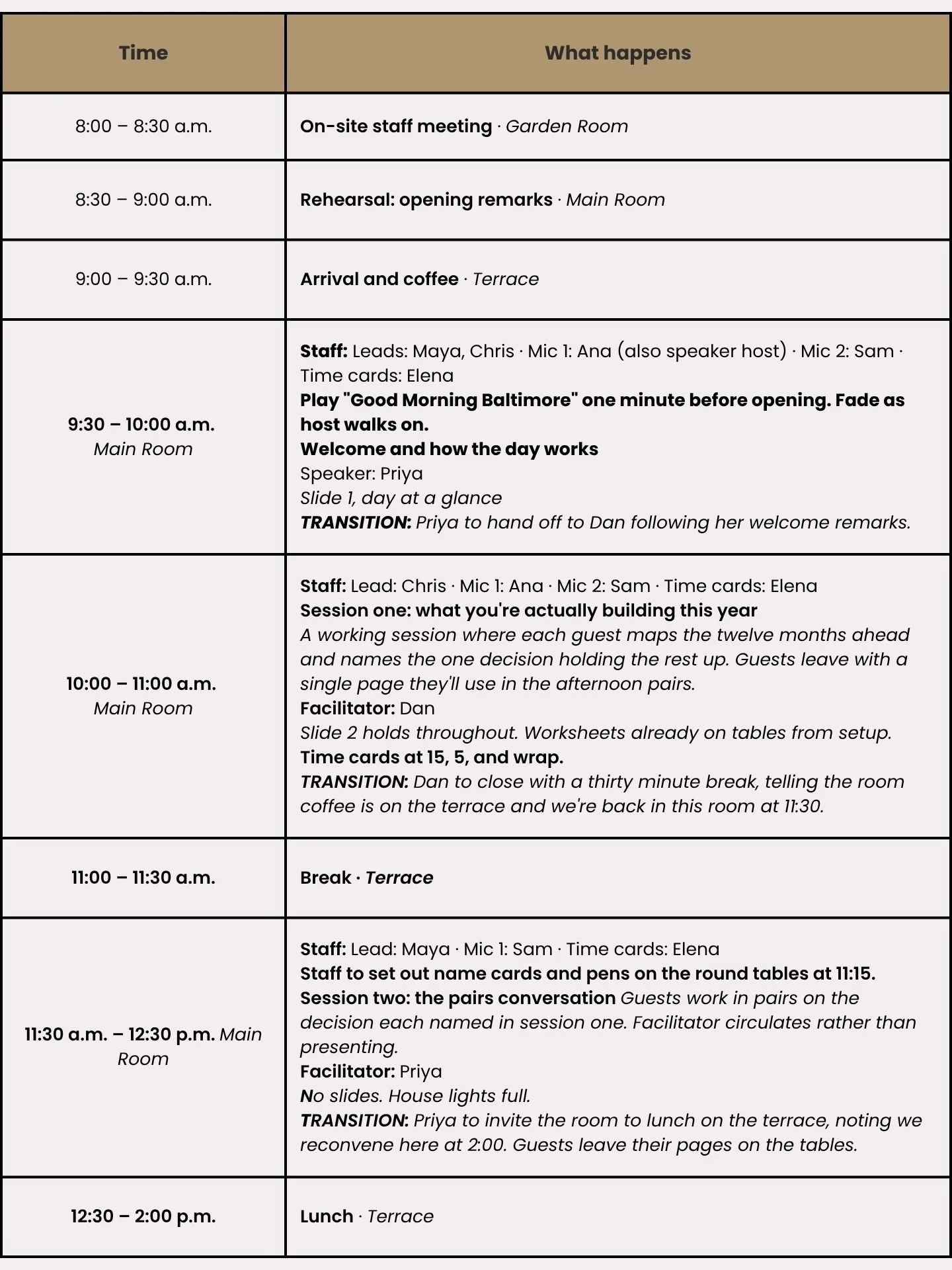
That's three hours of one day, and it's the reason twenty-four people experience a morning where nothing appears to be managed.
What tools to build it in
Ours mostly lived in a Word document, because a run of show is very wordy. The session descriptions and the transition lines need room to be full sentences, and a spreadsheet cell fights you on that.
Plenty of people run theirs in Google Sheets or Microsoft Excel, and it works fine, particularly when the day is more repetitive and less scripted. Sheets has one real advantage in the final week, which is real-time updates that everybody sees at once while the document is still changing hourly. A Word file that's been emailed around four times is a document nobody trusts.
Three things matter more than which tool you pick.
It has to be in order, top to bottom, so somebody can read it like a timeline rather than hunt through it.
Everyone working the day needs it on their phone, which means shared access sorted before the day, not on the morning.
Print copies for the production table. Venue wifi fails, phones die, and the one document nobody can afford to lose access to shouldn't depend on either.
What a run of show template gives you, and what it can't
A template is worth having. It gives you the columns, so you stop wondering whether mic assignments belong on this document, and it gives you a shape to react to rather than a blank page.
What a template can't do is know your day. The cues are yours. The names are yours. The decision about whether session one gets sixty minutes or forty-five is yours, and it's the kind of thing that changes twice in the final fortnight. A timeline template will give you the structure, and the technical details are the part you fill in yourself. That filling is most of the work, and it's also where the value is.
The thing worth having alongside a blank template is a finished one. Seeing the level of detail somebody else went to is worth more than being told what the level of detail should be, and it's the fastest way to find out you've been writing yours too loosely.
That's what I built the Event Day Run-of-Show Toolkit for. It has two fully built samples in it: a one-day retreat for twenty-five people and a two-and-a-half-day conference for two hundred, both with the music cues, mic swaps, staff rosters, and materials lists filled in. The blank template is in there too, along with a side-by-side of how a schedule, an agenda, and a run of show differ.
When you write it, and who reads it before the day
Start a rough version as soon as the shape of the day is settled, then expect it to change. The real build happens in the last two to three weeks, once speakers have confirmed their timings and the walkthrough has happened. There's more on what that stretch is for in the event planning checklist for your last two weeks.
Team coordination is the whole point of this document, so the last step before the day is making sure the people running it have actually read it. Three things need to happen. Your production team reads it and tells you what won't work, which is a real conversation and better had in advance. Your host reads her transition lines out loud, because that's how you find out one of them is clunky. The people working the room then get their own briefing, a shorter document drawn from this one, covered in the event day briefing your team actually needs.
Where to start
Open a blank document, draw two columns, and build the first three hours of your day at the level of the table above. Time blocks down the left, and in each cell the staff by name, the room, the cues, and the transition written out as a full sentence.
Three hours will take you longer than you expect, and it will show you exactly which decisions you haven't made yet. Everything a run of show asks for is a question you were going to have to answer on the day anyway, at a much worse moment.